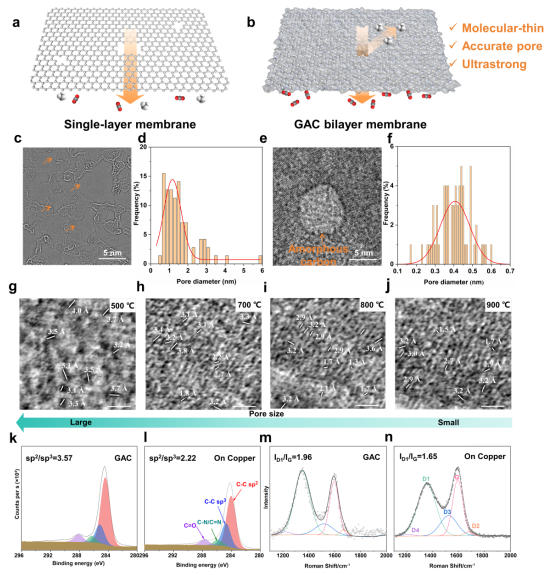
Next-generation carbon capture relies on membrane materials that simultaneously achieve molecular-level thinness, precise nanopore control, and exceptional mechanical robustness, a longstanding trilemma in membrane science. Here, we report graphene–amorphous carbon (GAC) bilayer membranes that overcome this challenge via a graphene-guided polymer conversion approach. Leveraging a super‑spreading effect, we uniformly coat graphene with an ultrasmooth, polymer‑derived carbon layer as thin as 2 nm, yielding outstanding mechanical strength with a Young’s modulus around 26.80 GPa. Meanwhile, controlled pyrolysis of the polymer precursor on graphene generates a carbon network containing high‑precision, narrowly distributed ultramicropores, as confirmed by atomic‑resolution electron microscopy. The resulting GAC membranes exhibit sharp molecular sieving (CO2/N2 > 60, H2/CO2> 70, CO2/CH4 > 70) alongside exceptionally high CO2 permeance up to 5000 GPU, surpassing the state-of-the-art membranes. This combination of normally conflicting properties enables highly efficient carbon capture from flue gas, syngas, and natural gas streams, establishing GAC membranes as a versatile and energy‑efficient platform for sustainable molecular separations.
Keywords: graphene, amorphous carbon, membrane separation, carbon capture.
Fig. 1 | Structural characterization of pores in GAC nanofilms. a, Schematic diagram of a single-layer membrane with widely distributed pores. b, Schematic diagram of a GAC bilayer membrane with precise pores. c, d, AC-HRTEM images and corresponding pore size distribution of SLG after 2 s plasma etching. e, f, AC-HRTEM image and simulated pore size distribution of GAC film. g-j, AC-STEM (Optimum Bright Field STEM) images of pore structures on GAC films after pyrolysis at different temperatures, the scale is 1 nm. A portion of the pores is measured and marked. k, l, XPS analysis of the 4 nm thick GAC film and amorphous carbon film directly coated on copper. m, n, Raman analysis of the 4 nm thick GAC film and amorphous carbon film directly coated on copper.